
CBAM hits your purchasing calculation. Before the first invoice arrives.
Regulatory clarity for importers, before data gaps turn into cost risks.
Since 1 January 2026 the CBAM carbon border adjustment has been fully in force. Anyone importing steel, aluminium, cement, fertiliser, hydrogen or electricity needs reliable data, a declarant status and a sense of the cost impact. We bring your position to a decision-ready basis in seven working days.
CBAM Readiness Panel
The obligation is here. The data usually is not.
CBAM is not a year-end form. It is a data chain from the foreign producer all the way into your customs declaration. Three things go wrong in practice.
Nobody knows what exactly is affected
CBAM hangs on the goods code. A single CN code decides whether a shipment falls under the obligation. Anyone who has not mapped their codes cleanly does not know their exposure.
The emission data is missing
Without actual values from the manufacturer, default values apply. These are deliberately conservative and rise further in 2026, 2027 and from 2028. Default values are the expensive option.
Responsibility is unclear
Procurement points to customs, customs points to finance, finance points to the board. CBAM falls into the gap between them, until a deadline or a query from the authority makes it visible.
The CBAM Decision File
A clearly defined product instead of open-ended consulting. In seven working days from blind spot to a file that gives the board, procurement and customs the same set of facts.
What is inside
- Exposure and threshold assessment based on your goods codes
- 7-field CBAM risk profile with a clear traffic-light rating
- Prioritised gap and action list, sorted by cost impact
- Indicative cost impact for 2026 and 2027
- Declarant and deadline overview for your case
- Template pack: supplier letter and data room structure
- Management summary for the board and CFO
What you need it for
You do not get an expert opinion to file away. You get a basis for decisions. Three questions answered afterwards:
- Am I affected, and if so, with what exactly?
- What will it probably cost me, and when?
- What has to happen by when, and who does it?
The 7-field CBAM risk model
We break CBAM down into seven testable fields. Each field gets a traffic-light rating. A diffuse regulatory topic becomes a map you can make decisions on.
Goods code & exposure
Which CN codes fall under CBAM. Where the obligation ends and where it begins.
Volumes & threshold
Cumulative annual volume against the 50-tonne threshold. Monitoring instead of guesswork.
Supplier data
Which manufacturers supply which data. Where the gaps in the chain are.
Emission data
Actual values against default values. The difference is hard cash.
Declarant status & deadlines
Authorised CBAM declarant, application, dates. Who files what with the German Emissions Trading Authority (DEHSt), and when.
Cost impact & budget
What the certificates will probably cost. Made plannable for finance.
Organisation & data room
Responsibility, documentation, ongoing upkeep. So it does not fall asleep again.
One picture instead of seven gut feelings
All fields together give your CBAM Score and the action plan.
The same file. Two ways to read it.
CBAM is a boardroom matter and day-to-day business at once. We serve both, without either side having to learn the other's language.
Risk, cost, decision
You want to know whether CBAM is a 5,000-euro or a 500,000-euro matter, and what it costs to ignore it. The management summary delivers exactly that, on one page.
For board & CFOFree: the briefing „CBAM 2026 for boards and CFOs“ as a PDF →
Data, codes, deadlines
You have to deliver: goods codes, supplier letters, emission data, on-time declaration. The file gives you templates and a sequence that works.
For procurement, customs & importWhat we do, and what we expressly do not.
What we do
- Check exposure and threshold
- Source, organise and assess data
- Calculate cost impact on an indicative basis
- Structure deadlines and declarant steps
- Set up templates and a data room
What we do not do
- No legal advice
- No tax advice
- No customs declaration in your name
- No certification or verification
- No representation before authorities
Where legal, tax or customs assessment is required, we work with your advisors or arrange the contact. Our strength is operational preparation, so that your advisors and the authorities work with clean data.
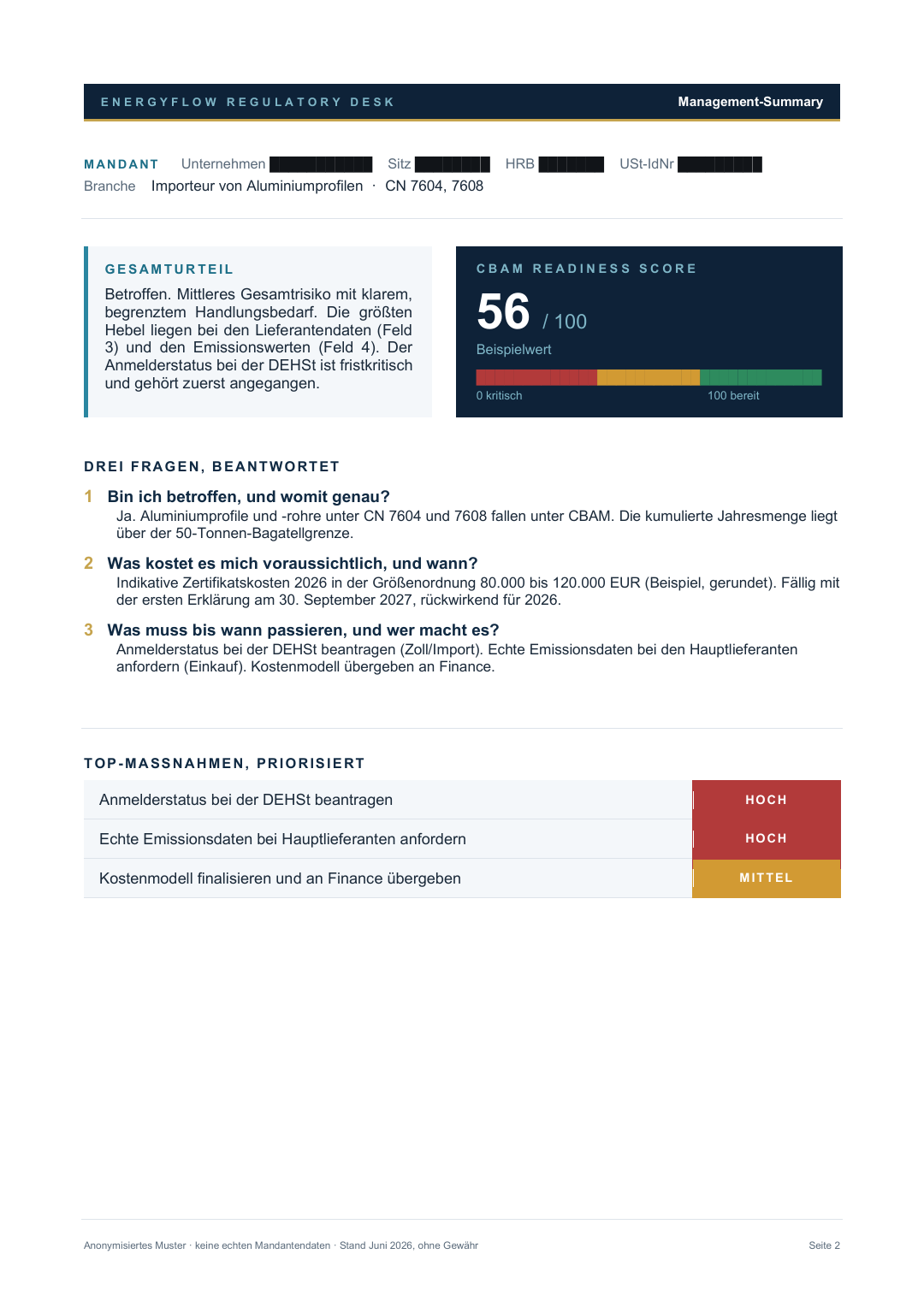
See what you get.
A fully anonymised sample file shows structure and depth of detail: management summary and 7-field risk profile, exactly as a real client receives them.
Clear up your CBAM status, before someone else does.
Start with the free self-test or speak with us for 30 minutes. After that you will know whether, and how urgently, you need to act.